

Documents & Presentations
Explore the full record of the Our Legacy Tulsa planning process. Here you’ll find community meeting presentations, open house boards, engagement reports, workshop materials, and the final Kirkpatrick Heights & Greenwood Master Plan with appendices. Greenwood Legacy Corporation shares these documents so residents, partners, and stakeholders can clearly see how community voices, data, and design informed each step of the work, and so the community can hold us accountable as we move from planning to implementation.
October 28 & 30, 2021
January 2022 -
March 2022
April 2022 -
June 2022
April Community Workshop Board
April Community Workshop Presentation
May Virtual Workshop
Draft Plan Review
Previous Plan Summaries
The Our Legacy Tulsa master planning efforts were built on prior plans and studies for this area. The plans identified clear strategies to align citywide resources, policies, and investment with the needs and priorities of the Kirkpatrick Heights / Greenwood community.
PlaniTulsa: Our Vision for Tulsa - Tulsa Comprehensive Plan
Adopted: July 2010
Updated: August 2016
Partners: City of Tulsa, Tulsa County, George Kaiser Family Foundation
Summary: Our Vision for Tulsa creates a framework of development for Tulsa over the next 20-30 years. Intended to be a guiding document, the comprehensive plan describes the kinds of places, economy, housing and transportation, parks, and open spaces that should be throughout Tulsa. Using extensive public engagement, the plan identifies five key themes under which the strategies fall under:
Have a Vibrant & Dynamic Economy
Attract & Retain Young People
Provide Effective Transportation
Provide Housing Choices
Protect the Environment & Provide Sustainability
Relevance to this plan: PlaniTulsa lays out an overarching vision and development framework for the entire City of Tulsa. This Master Plan will further explore how this vision and framework can be applied and expanded upon in the North Tulsa neighborhood, identifying specific locations and projects to help carry out that vision.
Downtown Streetscape Plan
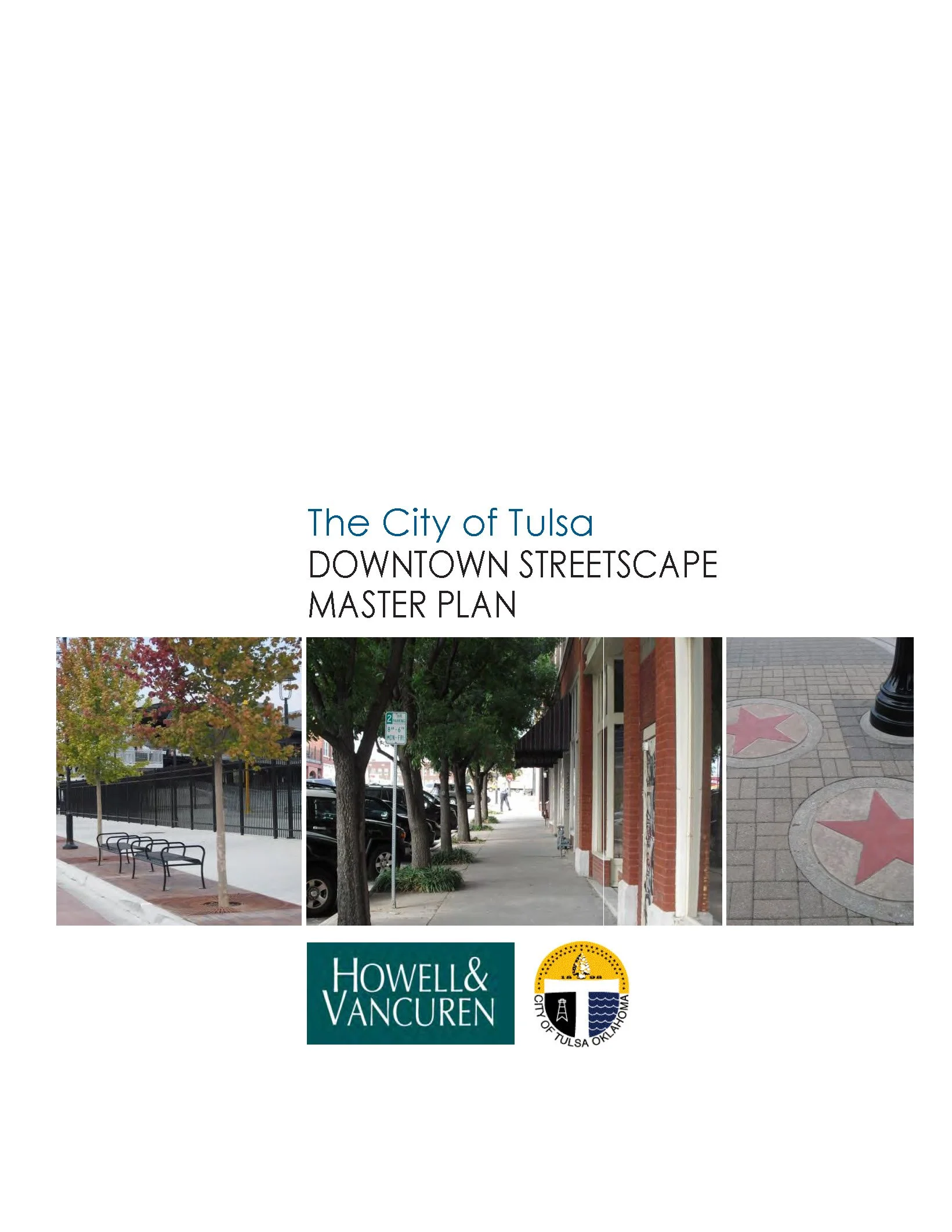
Adopted: May 2011
Partners: City of Tulsa, Downtown Coordinating Committee – Streetscape Planning Subcommittee
Summary: The Downtown Tulsa Streetscape Master Plan provides opportunities and recommendations for future design opportunities and a framework for funding on streetscape plans in the Downtown area. Including landscape and street tree placement and concept drawings at key intersections and gateways, as well as detailed guidance on design implementation and guidelines for tree species.
Evans-Fintube Roadmap to Redevelopment
Prepared: September 2015
Partners: City of Tulsa, Council of Development Finance Agencies
Summary: The Roadmap to Redevelopment was produced by the CDFA Brownfield Technical Assistance Program that aids brownfields communities on redevelopment and financing options. The Evans-Fintube site covers 22.3 acres north of Downtown and east of OSU-Tulsa. Formerly a steel manufacturing facility, the Evans-Fintube buildings are on the National Register of Historic Places as of December 2014. The document offers six recommendations and next steps on redevelopment:
Strategies on relocating the WATCO Rail Yard
Strategies and funding sources for implementing a site cleanup plan
Supporting a tax increment financing district (TIF)
Supporting a special assessment district overlay
Staging for Development – including steps on how to establish financing criteria for future developers
Planning for Evans-Fintube site improvements
City of Tulsa Bicycle & Pedestrian Plan

Adopted: December 2015
Partners: The Indian Nations Council of Governments (INCOG)
Summary: The Go Plan investigates the current challenges to active transportation and offers smart design and implementation recommendations to improve pedestrian and bicycle facilities. The Go Plan is a Bicycle/Pedestrian Master Plan that offers comprehensive improvements throughout the Tulsa region, and also includes community-specific plans for six communities – Bixby, Broken Arrow, Catoosa, Collinsville, Coweta, Glenpool, Jenks, Owasso, Sand Springs, Skiatook, and Tulsa. The plan offers strategies to improve walking and biking conditions to make active transportation a more appealing choice for transportation and recreation.
Unity Heritage Neighborhoods Plan

Prepared: November 2016
Partners: City of Tulsa, Tulsa Development Authority
Summary: The Unity Heritage Neighborhoods Plan offers a vision for the collective neighborhoods rich in history and culture. The plan offers recommendations that embody the spirit of the community, to position it for growth, economic and social prosperity, and long-term success. The Unity Heritage area encompasses a number of planning sector areas in the North Tulsa region that identify and relate to the local history of the Greenwood Avenue district, Black Wall Street, Lacy Park, and other landmarks. This plan updates and replaces a series of previous Sector Plans.
A Housing Strategy for Tulsa - Understanding the Cost of Harmful Homes
Prepared: August - December 2016
Prepared by: University of Tulsa College of Law Community Advocacy Clinic
Summary: This Housing Strategy outlines the major issues in Tulsa’s housing market, taking a deep look into the causes and effects of the laws and practices that have contributed to the poor housing quality. The study recommends strategies on how to address the issues, based on interviews, research, and review of models from other communities.
Tulsa Walkability Analysis
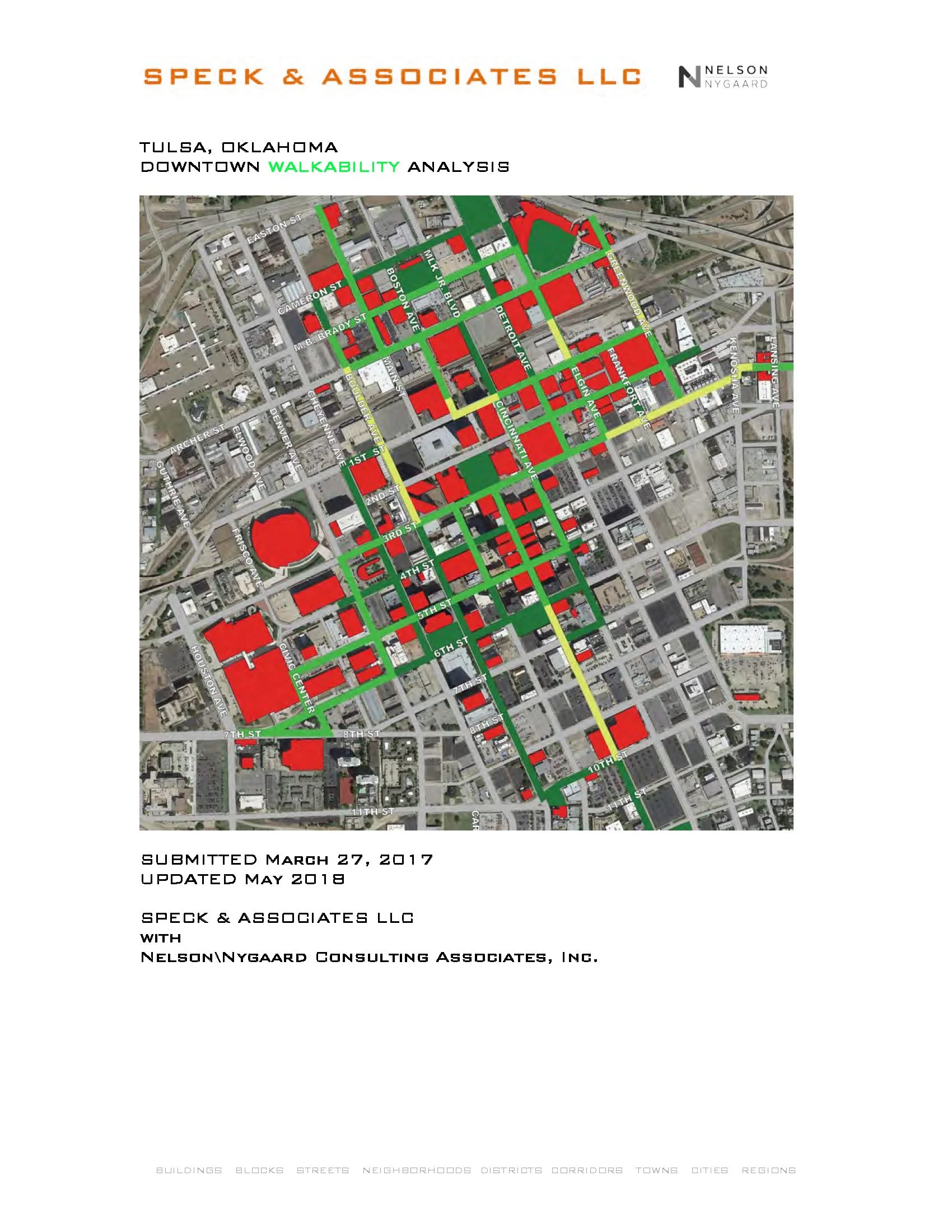
Updated: May 2018
Partners: Speck & Associates, LCC, Nelson Nygaard
Summary: The Walkability Analysis Report provides the current walkability status and conditions in Downtown Tulsa and provides strategies that aim to create a positive impact on the physical form, economic success, and social vitality of the city. The report is organized into six parts to frame the design strategy around walkability in a way that influences livability and vitality of Downtown Tulsa:
What Causes People to Walk?
A Safe Walk
Street Reconfigurations
A Useful Walk
A Comfortable and Interesting Walk
Setting Priorities
Resilient Tulsa
Adopted: 2018
Partners: City of Tulsa, 100 Resilient Cities
Summary: Resilient Tulsa is an equitable, action-oriented, and collaborative roadmap. It serves as a guidebook and cohesive vision to unite Tulsans, to become a world-class city for all people as part of the 100 Resilient Cities (100RC) initiative. Joining in 2014, Tulsa made a commitment to demonstrate leadership in resilience and taking advantage of the resources and opportunities of the 100RC network. Resilient Tulsa offers four long-term visions that provide an aspirational view to lead to a Resilient Tulsa in the future:
Create an inclusive future that honors all Tulsans
Equip all Tulsans to overcome barriers and thrive
Advance economic opportunity for all Tulsans
Transform City and Regional systems to improve outcomes for all Tulsans.
Relevance to this plan: The goals of Resilient Tulsa align with the goals of Our Legacy, Our Community, both of which are seeking to address critical resilience challenges. While Resilient Tulsa takes a citywide approach, this plan will dive deeper into North Tulsa to identify the community’s critical issues and opportunities.
Retail Market Study & Strategy
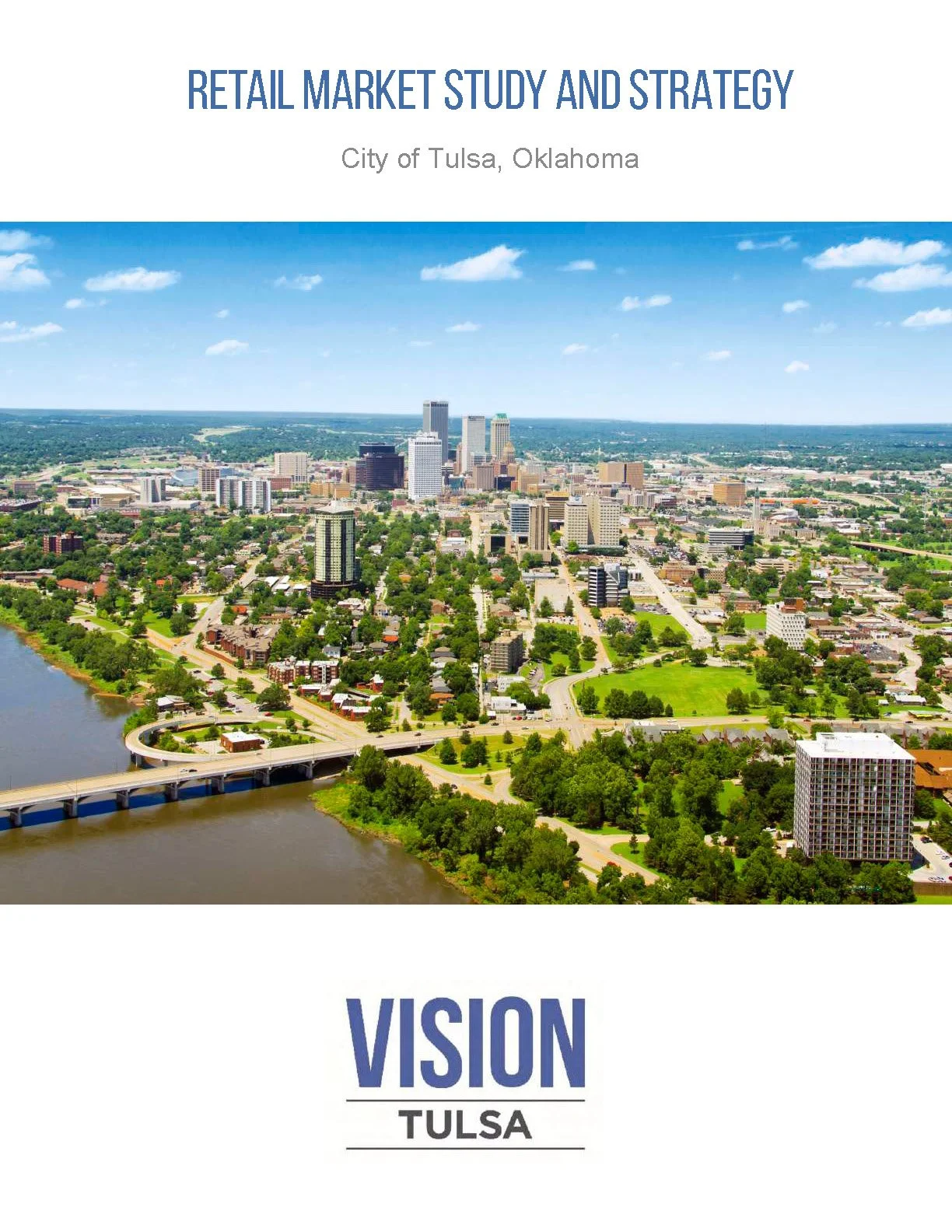
Prepared: 2019
Partners: City of Tulsa, Place Dynamics LLC, Economic Development Commission
Summary: This study was conducted to understand, anticipate, and plan for the retail environment for the City of Tulsa. It examines the market conditions at a broad level and in more granular detail in 13 target study areas, identifying the trends, strengths, weaknesses, and opportunities at the neighborhood and metropolitan scale. Key trends highlighted in the study show that Tulsa is seeing similar changes in the retail industry as seen nationwide, with retail growth happening in the suburbs leading to less demand in the city.
Tulsa Equity Indicators Report
Prepared: Annual Report 2019
Partners: Community Service Council, City of Tulsa, CUNY Institute for State and Local Governance, The Rockefeller Foundation
Summary: Tulsa was selected, with four other cities, to create a city-specific Equality Indicators (EI) tool in 2017 that is managed by the Mayor’s Office of Resilience and Equity. The EI annual report is to track the changes in outcomes for Tulsa residents, confront disparities, and work with local leaders and institution to reduce disparity and expand equity. The findings from this report are meant to guide public policy, identify problem areas, and inform solutions that lead to improved outcomes for disadvantaged Tulsans. The EI tool is a longitudinal analytic framework to measure inequalities. Data is disaggregated and analyzed by: race, income, geography, age, educational level, English proficiency, gender, disability status, veteran status, and mode of transportation.
The group facing disparities for the greatest number of indicators is African Americans, followed by North Tulsa residents.
Six themes form the foundation of the tool:
2019 Equality Indicators score for the City of Tulsa: 41.74 out of 100 (40.02 in 2018)
Public Health: 50.56
Education: 43.67
Housing: 42.11
Services: 40.33
Economic Opportunity: 39.99
Justice: 33.89 (which went down from 2018)
Downtown & Surrounding Neighborhoods Housing Study & Strategy
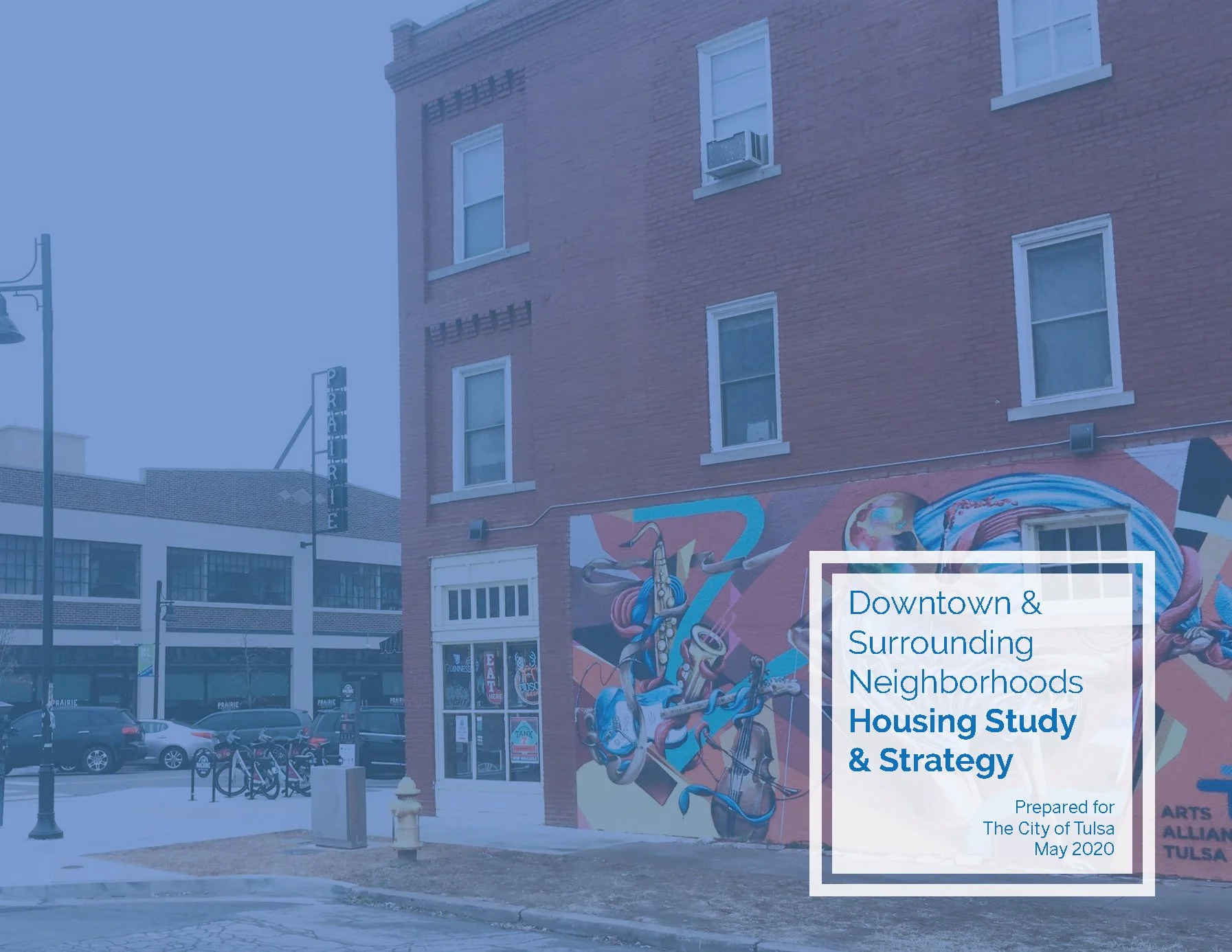
Prepared: May 2020
Partners: City of Tulsa, INCOG
Summary: This housing study and strategy was commissioned to assess the housing needs of Downtown Tulsa and the surrounding neighborhoods to create a holistic development and policy framework to guide equitable housing investments. The study found that since the previous housing study (conducted in 2010), Downtown Tulsa and the surrounding neighborhoods have experienced significant growth and reinvestment and could support additional housing to meet the growing demands. The study identified the deep need for affordable housing and housing for the “missing middle.” The strategy identified five overarching goals:
Expand the quality and accessibility of affordable housing
Support economic development and competitiveness
Reduce barriers to homeownership
Improve housing stability
Leverage housing investment and neighborhood stabilization and quality of life